Marketing launches a live shopping pilot, reports engagement metrics, and the initiative quietly dies. The fix isn't better content — it's better ownership.
QUICK ANSWER — Live social shopping stalls when marketing owns it as a campaign. Ecommerce teams must co-own the program — handling replay distribution, PDP integration, margin tracking, and attribution — while marketing focuses on audience and content. Programs with cross-functional ownership sustain significantly higher ROI because they connect video content to the full purchase funnel.
Table of Contents
- What live social actually is (and what it is not)
- The campaign trap: why marketing-only ownership caps ROI
- Which teams own which layer of a live social program
- How replay and PDP distribution shift ownership to ecommerce
- Attribution and margin visibility: the data team's role
- Building the internal operating model in 90 days
- Frequently Asked Questions
In China, social commerce accounts for 47% of all ecommerce revenue. In Western markets, most brands can't keep a live shopping pilot alive past two quarters. The gap isn't cultural — it's structural: marketing launches a live social shopping initiative, runs a handful of shows, reports view counts and emoji reactions, and the CFO pulls the budget because nobody can connect those metrics to margin.
What live social actually is (and what it is not)
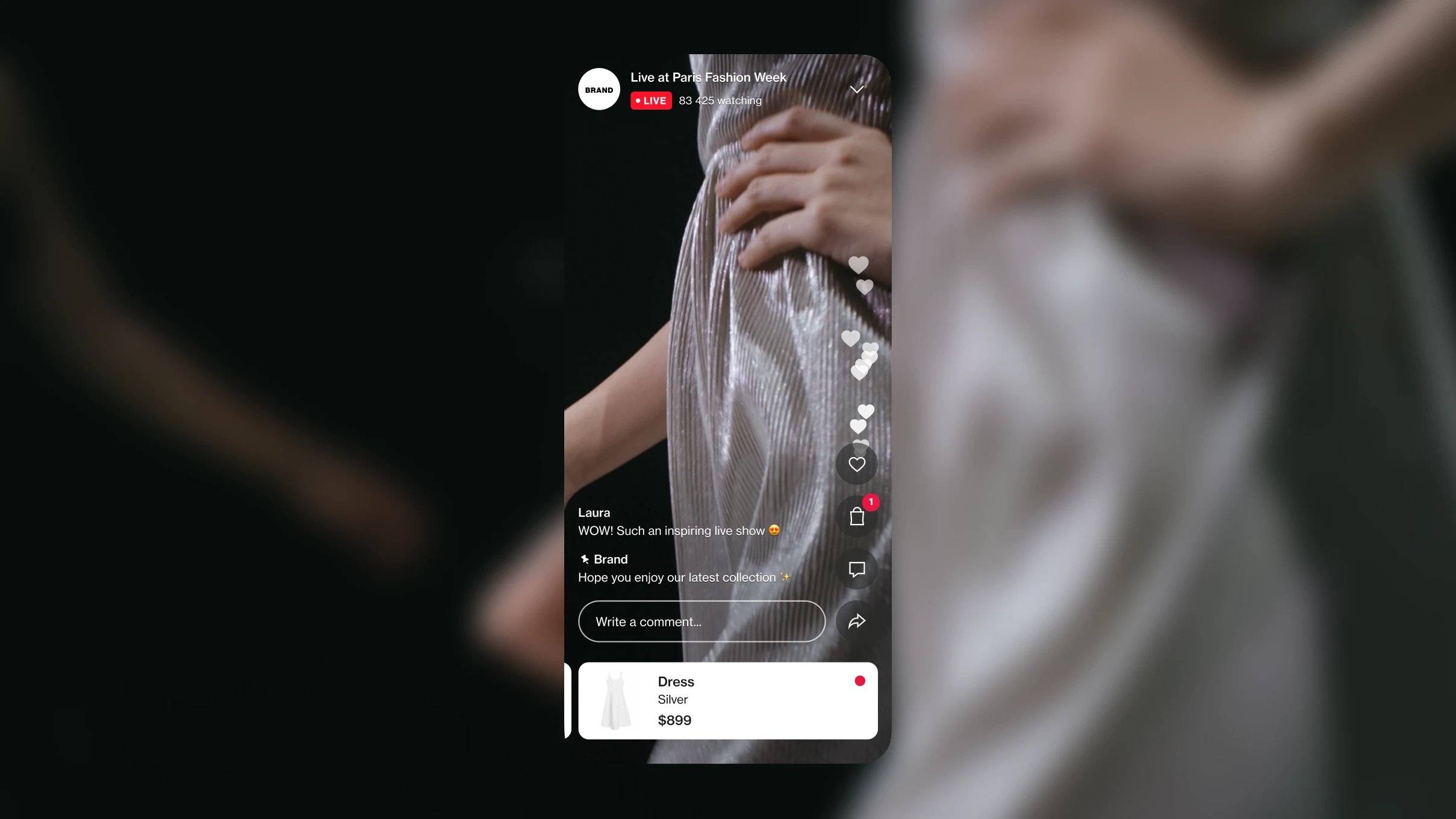
Live social shopping combines real-time video broadcast with in-stream product interaction — viewers watch a host demonstrate products and can browse, ask questions, and add items to cart without leaving the video. That boundary matters because it determines who should own the program — and what infrastructure it needs.
A pre-recorded product video on a category page is not live social. Neither is a TikTok haul video with a link in bio. Those formats lack the two-way interaction layer — polls, live chat, product overlays triggered by viewer behaviour — that separates a shoppable broadcast from a passive viewing experience. The "social" element refers to the real-time feedback loop between host and audience, not the platform where the video happens to air.
Where brands get confused is in equating the format with the channel. Running a live show on Instagram doesn't automatically make it social commerce — social commerce is the broader category of selling through social interactions, and it includes everything from influencer affiliate links to community-driven group buys. Live shopping is one mechanism within that category, defined by its synchronous, interactive, video-first structure.
Two features distinguish a mature live shopping program from a one-off event. First, in-video commerce: the ability to browse product cards, select variants, and add to cart inside the player. Second, data capture at the interaction level — not just "who watched" but "who clicked which product at which timestamp, and did they convert." Without both, you have a webinar with a shopping link, not a commerce channel.
This distinction drives ownership decisions. A webinar belongs to marketing. A commerce channel — with inventory implications, margin targets, and attribution requirements — belongs to the business. That mismatch is where most pilots go wrong before the first show even airs.
The campaign trap: why marketing-only ownership caps ROI
Marketing teams are built to generate demand. They think in campaigns: a start date, an end date, a creative brief, a performance report. When a live shopping pilot lands on marketing's desk, it gets the campaign treatment. A content calendar goes up. Three to five shows get scheduled. The team measures views, engagement rate, maybe social shares.
Here's the problem. Campaign metrics don't answer the question the CFO is asking, which is: "Did this sell enough product at a healthy enough margin to justify the production cost?" Engagement rate is a leading indicator, not a business outcome. When the quarterly review arrives and marketing presents a deck full of average watch times, the executive team sees cost without return. Budget gets reallocated. The pilot dies.
This pattern repeats because the incentive structures are misaligned — and nobody notices until the budget review. Marketing gets measured on reach and engagement. Ecommerce gets measured on revenue per session and conversion rate. When marketing owns the live shopping program alone, nobody is accountable for the metrics that keep the budget alive.
A second failure mode compounds the first. Marketing-led programs rarely extend content beyond the live moment. The show airs, gets a few social clips, and the full recording sits in a content management system gathering dust. No one embeds the replay on product detail pages. No one tags the video for search. No one feeds the interaction data into social commerce strategies that could compound the content's value over time. No one connects the viewer journey to downstream purchases that happen hours or days later. The result: a single-use asset in a format that should generate weeks of on-site value.
The fix is not to take the program away from marketing. Marketing brings audience-building skills, creative direction, and host talent that ecommerce teams typically lack. Removing marketing creates a different failure — technically competent shows that nobody watches. The fix is shared ownership with clear accountability lines, where each team controls the layer it's best equipped to manage.
Which teams own which layer of a live social program
A working live shopping program has four layers, and each one maps to a different team's core competency.
Content and audience (Marketing). Marketing decides the editorial angle — whether a show is a product launch, a styling session, or a Q&A with a brand ambassador — and drives the audience to the stream through email, paid social, and on-site banners.
Commerce integration (Ecommerce). Ecommerce decides which SKUs appear in the show, ensures stock levels can handle a demand spike, and configures any show-exclusive offers.
Post-show distribution (Ecommerce + Merchandising). After the broadcast ends, the recording becomes an on-demand asset — and this is where 60–80% of total program revenue typically sits. Ecommerce and merchandising decide where it lives: on which PDPs, in which category pages, in what order relative to static images.
Measurement and attribution (Data/Analytics). The data team builds the attribution model that connects a live show interaction to a purchase — whether that purchase happens during the stream, three hours later on a PDP, or the following week via a retargeting ad.
| Layer | Owner | Core Responsibility | Primary KPI |
|---|---|---|---|
| Content & Audience | Marketing | Show calendar, host selection, pre-show promotion | Qualified viewership |
| Commerce Integration | Ecommerce | Product feed, pricing, inventory, cart | Revenue per show, conversion rate |
| Post-show Distribution | Ecommerce + Merchandising | Replay placement on PDPs and category pages | Replay revenue, PDP engagement |
| Measurement & Attribution | Data / Analytics | Attribution model, margin reporting | Attributed revenue, margin contribution |
Key takeaway: When every layer has a named owner and a measurable KPI, the program survives budget cycles because accountability is distributed, not concentrated in marketing.
This structure turns a live social shopping program into a standing function rather than a recurring campaign. Campaigns end. Functions persist. When each team has a defined role and a KPI they control, the program survives leadership changes, budget cycles, and the inevitable quarter where show attendance dips.
How replay and PDP distribution shift ownership to ecommerce
Most of the commercial value from a live show happens after the broadcast ends. Retailers running weekly shows consistently report that replay views outnumber live viewers by a factor of three to five within the first 30 days. Yet in marketing-led programs, the replay often gets treated as an afterthought — posted to a brand's "Live" page and forgotten.
Ecommerce teams think differently about content placement. They think in terms of product detail pages, category hierarchies, and the path from discovery to cart. When ecommerce owns replay distribution, the recording gets broken into product-specific clips and embedded on the PDPs where purchase intent is highest. A 40-minute show about summer dresses becomes six shoppable clips, each sitting on the PDP of the dress it features, playing for every visitor who lands on that page from search or browse.
Kappahl, the Scandinavian fashion retailer, demonstrated what this shift looks like in practice. After rolling out a miniplayer across all product detail pages — allowing shoppers to watch relevant video clips while browsing — they saw a 136% increase in live video sales. Average order value rose 30%, and return rates dropped. Those results came not from running more shows but from distributing existing show content more intelligently across the site.
The operational implication is clear. If replay distribution drives the majority of revenue, then the team responsible for on-site merchandising — ecommerce — must own that layer. Marketing can advise on creative sequencing. But the decisions about which clips appear on which pages, how they rank against static images, and when they rotate out belong to the people who manage the product catalogue.
Platforms that auto-detect product moments in ended live shows and generate tagged clips without manual editing make this handoff practical. Without automation, the content operations burden is too high for most ecommerce teams to absorb. With it, a single live show becomes a library of on-demand assets that the merchandising team deploys like any other product content.
Attribution and margin visibility: the data team's role
Attribution is where live shopping programs either earn permanent budget or lose it. The challenge is unique to this format: a viewer might watch 12 minutes of a live show on Tuesday, leave without buying, return to the PDP on Thursday after seeing a retargeting ad, and convert. Standard last-click attribution credits the retargeting ad. The live show — the moment that created the intent — gets zero credit.
Data teams need to build an attribution model that accounts for three touchpoints specific to live and shoppable video. First, in-stream product interactions: clicks on product cards, variant selections, add-to-cart actions that happen inside the player. Second, post-stream site behaviour: did the viewer visit a PDP within 24 or 48 hours of watching? Third, assisted conversions: purchases where the video interaction was not the last click but appeared in the path.
This isn't theoretical. China's ecommerce market generated almost $1.5 trillion in online sales last year, and the live shopping infrastructure there includes granular, event-level attribution as standard. Western brands are still catching up, but the data plumbing exists. Google Tag Manager events, custom UTM parameters for each show, and server-side tracking of video-to-cart journeys all feed into the attribution model.
Margin visibility matters just as much as revenue attribution. A live show that drives $50,000 in GMV sounds impressive until you learn that 60% of the sales came from a deeply discounted hero product with 8% margin. The data team's job is to connect show-level revenue to SKU-level margin, so the ecommerce team can make informed decisions about which products to feature and what promotional mechanics to use.
One practical output: a post-show report that breaks down revenue by SKU, margin contribution, new-versus-returning customer split, and attributed versus direct conversion. Bambuser data shows that shoppers exposed to shoppable video are 225% more likely to add items to cart — but that number only becomes actionable when the data team can trace it through to margin. When this report exists, the quarterly budget conversation changes. Instead of "here's our engagement rate," the team presents "here's the incremental margin this program generated, net of production costs." That's a conversation the CFO wants to have.
Building the internal operating model in 90 days
Ninety days is enough time to move from a marketing-only pilot to a cross-functional operating model. Not enough time to perfect it — but enough to establish the roles, run the first integrated shows, and produce a margin-attributed performance report that earns the next quarter's budget.
Days 1–30: Define ownership and instrument the stack
Assign a program lead from ecommerce — not marketing. This person doesn't replace the marketing lead; they sit alongside them with equal authority. The program lead owns the P&L for the live shopping function. During this phase, the data team instruments the video player and site analytics to capture in-stream interactions, post-stream PDP visits, and conversion events. If your video commerce platform supports event-level tracking through GTM, configure it now. A well-instrumented video commerce player fires granular commerce events — product clicks, add-to-cart actions, checkout initiations — that pipe directly into your existing analytics stack.
Days 31–60: Run three integrated shows and distribute replays
Marketing handles audience and content. Ecommerce selects SKUs based on margin targets and inventory depth, not just what looks good on camera. After each show, the ecommerce team breaks the recording into product-specific clips and places them on the relevant PDPs. The data team tracks both live and replay performance, building the first version of the attribution model.
During this phase, establish a weekly 30-minute sync between marketing, ecommerce, and data. Review what sold, what didn't, where viewers dropped off, and which replay clips are generating PDP engagement. Adjust the next show's product mix based on actual data, not creative instinct alone.
Days 61–90: Produce the first margin report and lock in the cadence
By now you have data from three shows plus 30–60 days of replay performance. The data team produces the first integrated report: GMV, margin contribution, attributed revenue (live + replay + assisted), production cost, and net margin impact. Present this to the executive team.
If the numbers are positive, propose a standing cadence — weekly or biweekly — with a defined annual budget. If the numbers are mixed, identify the bottleneck. Low viewership is a marketing problem. Low conversion is an ecommerce problem (wrong SKUs, weak offers, poor cart integration). Low replay performance is a distribution problem. The operating model gives you the diagnostic framework to fix the right thing instead of scrapping the entire program.
Matas, the Danish beauty retailer, followed a similar trajectory. They started with occasional shows and evolved into a twice-weekly cadence with a dedicated editorial team. Across more than 300 shows, they averaged 15% engagement rates and 14-minute view times. That consistency came from treating live shopping as an ongoing function with cross-team accountability, not a series of one-off marketing experiments.
Frequently Asked Questions
How is live social different from livestream selling on TikTok or Instagram?
Livestream selling on TikTok or Instagram relies on the platform's native player, algorithm, and checkout infrastructure. The brand controls the content but not the commerce experience, the data, or the audience relationship. Live social shopping on a brand's own site uses an embeddable video player with full cart integration, product overlays, and interaction tracking — all connected to the brand's ecommerce stack. The key differences are data ownership (you capture every interaction as first-party data), checkout control (the shopper buys through your cart, not the platform's), and replay distribution (you place the recording wherever it drives the most value on your site). Brands running shows on social platforms often see high viewership but low conversion because the path from video to purchase crosses multiple screens and experiences.
What KPIs should ecommerce teams track for live social beyond GMV?
GMV is the headline number, but four supporting KPIs matter more for long-term program health. First, conversion rate from viewer to buyer — this tells you whether the show is reaching purchase-ready audiences. Second, revenue per viewer, which combines conversion rate and average order value into a single efficiency metric. Third, replay-to-live revenue ratio, which shows how much value the content generates after the broadcast ends; a healthy program sees 60–80% of total revenue from replays. Fourth, margin contribution per show — net revenue after subtracting production costs and any promotional discounts. Track these weekly, and you'll spot problems before they become budget threats.
Can live social content be repurposed on product detail pages after the live event?
Yes, and this is where the majority of commercial value sits. After a live show ends, the recording can be broken into product-specific clips and embedded directly on the PDPs of the featured items. Some video commerce platforms auto-detect product moments in the recording and generate tagged, shoppable clips without manual editing. These clips play for every visitor who lands on the PDP — from organic search, paid ads, or browse — turning a single live event into weeks of on-demand selling content. Brands that embed replay clips on PDPs consistently see higher add-to-cart rates on those pages compared to pages with static images alone.
How do you attribute revenue from a live social session when the purchase happens later?
Build a multi-touch attribution model that tracks three event types: in-stream product interactions (clicks, add-to-cart actions inside the video player), post-stream PDP visits within a defined lookback window (typically 24–72 hours), and assisted conversions where the video interaction appeared in the purchase path but was not the final click. Instrument your video player to fire custom events into Google Tag Manager or your analytics platform, and assign each show a unique campaign identifier. This lets you measure both direct conversions (purchased during or immediately after the show) and influenced conversions (purchased later, with the show as a documented touchpoint). Without this model, last-click attribution will systematically undervalue the live shopping program and put its budget at risk.




.png)