Furniture brands lose high-AOV sales not because of bad photography, but because static images can't answer the doubts that stall a $1,000+ checkout. Here's how to match each hesitation to the video format that resolves it.
QUICK ANSWER — Selling furniture online video works because it matches specific buyer doubts — scale, fabric texture, room fit, assembly complexity — to the video format designed to resolve each one. Brands that pair shoppable clips, live demonstrations, and one-to-one consultations with their PDPs see significantly higher conversion and lower return rates on big-ticket items.
Table of Contents
- Five Hesitations That Kill $1,000+ Furniture Sales — and Why Photos Make Them Worse
- Which Video Format Resolves Which Doubt: A Matching Framework
- One-to-One Video Consultation: Where Design Advice Replaces Showroom Visits
- What to Evaluate Before Adding Video to Furniture PDPs
- The Return-Rate Argument That Justifies the Investment
- Common Objections from Furniture Ecommerce Teams — and Honest Answers
- Frequently Asked Questions
Furniture PDPs above $1,000 lose roughly 77% of shoppers between add-to-cart and completed checkout, according to Baymard Institute cart-abandonment benchmarks. For selling furniture online video is the format that closes that gap — yet most brands respond to hesitation by uploading a seventh hero image instead of addressing the specific doubt that stalled the purchase. This article gives you a matching framework: five buyer hesitations, the video format that resolves each one, and the implementation criteria that separate a revenue-generating rollout from an expensive content project.
Five Hesitations That Kill $1,000+ Furniture Sales — and Why Photos Make Them Worse
Every high-AOV furniture PDP faces the same five objections. Buyers wonder whether the sofa will actually fit their living room, whether the fabric looks the same outside studio lighting, whether assembly requires an engineering degree, whether the style clashes with existing pieces, and whether an eight-week lead time on a made-to-order item is worth the risk. Static photography, no matter how polished, answers none of these convincingly.
Scale is the clearest example. In-situ photography places a sectional in a professionally staged room with no familiar reference objects. The buyer still cannot judge whether it overwhelms a 12-by-14-foot apartment living room. Colour matching fails for the same reason — studio-lit fabric swatches flatten texture and shift hue. A customer choosing between oatmeal linen and stone bouclé needs to see how light moves across the weave, not a flat colour chip.
Assembly complexity and style compatibility are even harder to convey in stills. A carousel of hardware close-ups tells the buyer nothing about the 45 minutes they will spend with an Allen wrench. And no amount of lifestyle staging resolves the question: "Does this mid-century credenza work next to my existing industrial shelving?" These doubts are experiential. To resolve these doubts, selling furniture online video offers a format that moves, speaks, and responds.
Which Video Format Resolves Which Doubt: A Matching Framework
Not all video is equal. A 15-second product spin does nothing for someone worried about custom upholstery lead times. The framework below maps each hesitation to the format with the highest resolution power.
1. Scale and room dimensions → Shoppable video with real-room context. Embed a 60-to-90-second clip filmed in an actual apartment, not a warehouse studio. Include everyday objects — a coffee mug on the side table, a person sitting on the sofa — so the viewer calibrates size instantly. Tag the product in-video so the add-to-cart action happens inside the content, not after a scroll back to the PDP.
2. Fabric texture and colour accuracy → Close-up video under natural light. A slow pan across the material, filmed near a window, communicates more about stain resistance and hand-feel than a swatch card. Pair it with a voiceover naming the fabric weight and pet-friendly rating.
3. Assembly complexity → Narrated build video. Real-time or lightly edited footage of someone assembling the product, calling out tool requirements and tricky steps. As a tool for selling furniture online video converts flat-pack sceptics better than a PDF instruction sheet ever will.
4. Style compatibility → Live shopping event with a home stylist. A stylist walks through room combinations, mixing the featured piece with different interior styles — Scandi, industrial, transitional. Viewers ask questions in real time and see answers demonstrated on camera.
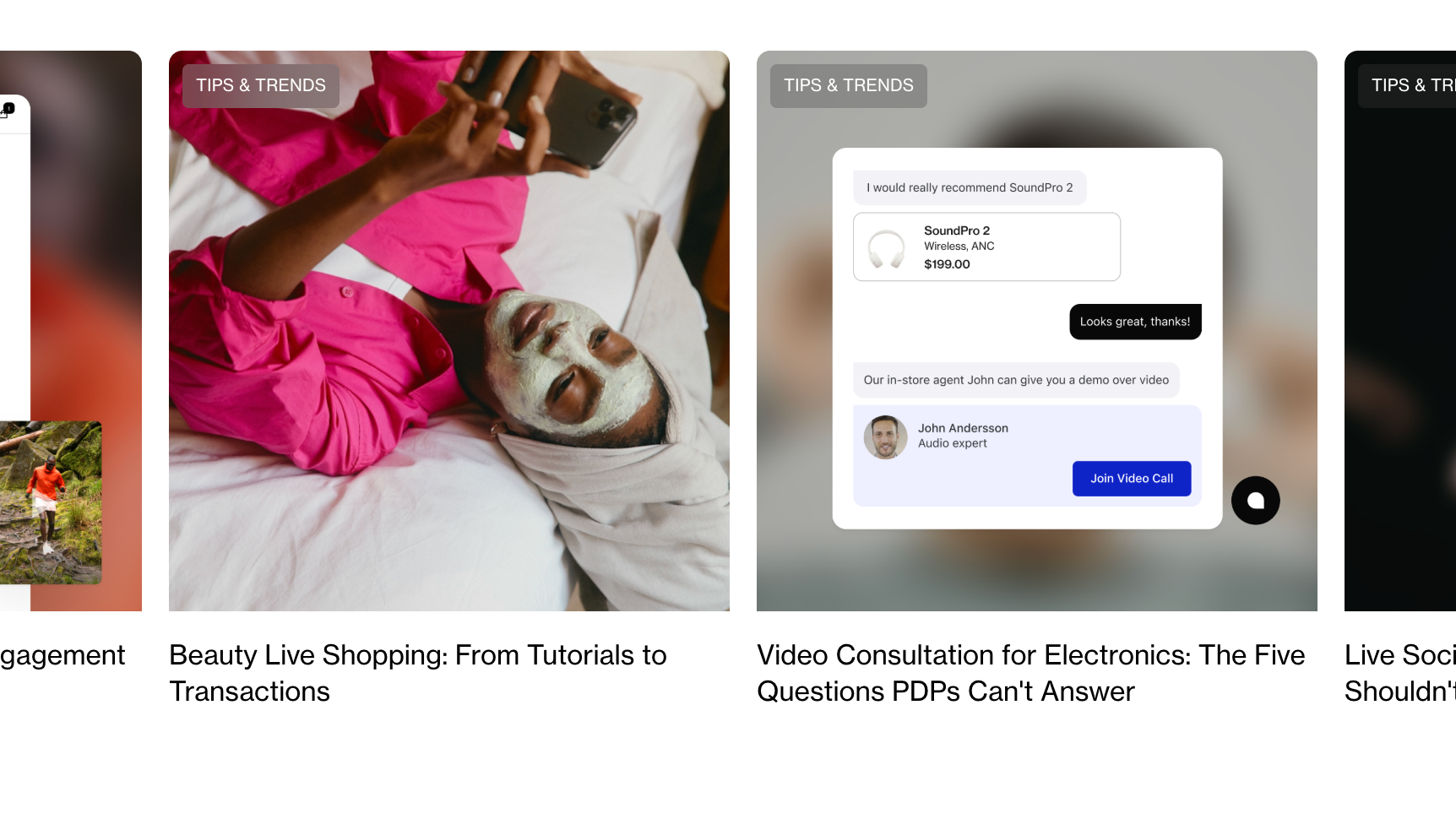
5. Lead-time anxiety on made-to-order items → One-to-one video consultation. A design advisor confirms specifications, walks through the production timeline, and shows material samples on camera. The buyer commits because a human confirmed the details, not because a tooltip said "ships in 6–8 weeks."
One-to-One Video Consultation: Where Design Advice Replaces Showroom Visits
The showroom exists because furniture is a considered purchase. Buyers want to sit on the sofa, touch the wood grain, and ask a knowledgeable person whether the dining table seats six or eight comfortably. Video consultation replicates that interaction digitally — and in some cases outperforms it, because the advisor can pull up the buyer's room photos, compare swatches side by side on screen, and share durability ratings without leaving the call.
Elkjøp, the largest Nordic electronics retailer, runs over 3,000 video consultation sessions per week with a 30% conversion rate and an average order value of $470, according to their published results. The model translates directly to furniture: high-consideration, high-AOV products where a single answered question tips the buyer from browsing to buying. A customer debating a $2,400 modular sectional in custom fabric needs ten minutes with someone who can confirm that the chaise fits a left-wall configuration. That conversation, on video, replaces a 40-minute drive to a showroom.
For made-to-order brands, the consultation also reduces costly errors. When the advisor and the buyer agree on dimensions, fabric, and configuration during a recorded session, the order arrives right the first time. White-glove delivery on a wrong-spec sofa costs the brand more than the consultation infrastructure ever will.
What to Evaluate Before Adding Video to Furniture PDPs
Before committing budget to selling furniture online video, answer four questions honestly.
Does your product catalogue justify video? If your average order value sits below $300 and your return rate is already under 5%, the ROI case weakens. Video commerce earns its keep on items where hesitation is high and returns are expensive — think sofas, dining sets, bed frames, and custom storage.
Can you produce content at a sustainable pace? One hero video per SKU is a start, but the real value comes from a library of room-context clips, assembly walkthroughs, and consultation recordings that feed your PDPs over time. Platforms that auto-generate tagged clips from longer recordings cut production time dramatically.
Does your tech stack support embedded video with cart integration? A YouTube embed is not shoppable video. The player must sync with your product feed — prices, stock levels, and variants updating in real time — so the viewer never leaves the video to check availability.
Is your team ready for live interaction? Shoppable clips require no live staffing. But live shopping events and one-to-one consultations need trained hosts or advisors who know fabric specs, lead times, and space-planning basics. If your customer service team already handles phone consultations, the transition is shorter than you think.
The Return-Rate Argument That Justifies the Investment
Returning a sofa is not like returning a sweater. The logistics cost of a white-glove pickup on a $1,500 sectional can exceed $200 before restocking. Multiply that across a 15% return rate and the number dwarfs any video production budget.
Bambuser data shows products purchased through video carry a 40% lower return rate compared to standard ecommerce purchases. The mechanism is straightforward: when a buyer watches a real person demonstrate scale, fabric, and assembly before purchasing, the gap between expectation and reality shrinks. Kappahl, a Scandinavian fashion retailer, reported lower return rates on video-assisted purchases alongside a 30% higher AOV from live shows — evidence that the pattern holds across high-consideration categories.
For furniture specifically, the return-rate argument is the fastest path to CFO approval. Frame the investment not as a marketing expense but as a logistics savings initiative. A 10-point reduction in return rate on your top 20 SKUs likely pays for the entire selling furniture rollout within two quarters.
Common Objections from Furniture Ecommerce Teams — and Honest Answers
"Our photography is already best-in-class." Great photography gets the buyer to the PDP. It does not answer the question they have at the PDP. A beautifully lit hero image of a walnut credenza still cannot show whether the drawers glide smoothly or whether the finish looks warm under LED lighting. Photography and video solve different problems at different stages of the funnel.
"Video slows down page load." A valid concern — if you embed raw MP4 files. Modern video commerce players load asynchronously and add minimal impact to Core Web Vitals. Ask any vendor for Lighthouse scores on live client pages before signing.
"We don't have the team to go live." You don't need to start with live events. Begin with shoppable clips on your top 10 PDPs — pre-recorded, tagged, and embedded. Live shopping and consultations can layer in once the content workflow is stable. selling furniture does not require a broadcast team on day one.
"Our customers are older and won't watch video." According to Coresight Research, trust and product quality are the primary drivers of purchase decisions in live video commerce — not age demographics. Buyers aged 45–65 are the fastest-growing segment for high-AOV video-assisted purchases because they have the most to lose from a wrong decision on a $2,000 item.
Frequently Asked Questions
How long does it take to implement shoppable video on furniture product pages?
Most ecommerce teams can embed shoppable video on their first PDP within one to two weeks using a platform with native Shopify or SFCC integration. The initial setup — connecting your product feed, configuring the player, and uploading your first batch of clips — typically takes three to five business days. Scaling across your full catalogue depends on content production speed, not technical complexity. Brands that repurpose existing video assets (showroom walkthroughs, supplier footage, social content) often cover their top 20 SKUs within 30 days.
Does video actually reduce return rates on bulky furniture items?
Yes. Video gives the buyer accurate expectations about scale, colour, material texture, and assembly before they commit. When a customer sees a real person sitting on a sofa in a real living room, they calibrate size far more accurately than from a dimensioned line drawing. Bambuser's cross-category data shows a 40% lower return rate on video-assisted purchases. For furniture brands, where a single return can cost $150–$300 in logistics alone, even a modest reduction pays for the video infrastructure within months.
How do customers ask about fabric and scale during a video consultation?
Customers typically share a photo of their room or describe their space dimensions at the start of the call. The advisor then holds fabric samples to the camera under natural light, compares colours against the customer's existing pieces shown on screen, and uses a tape measure or familiar objects to demonstrate scale. Some advisors use a split-screen view showing the product in a staged room alongside the customer's own space photo. Questions about stain resistance, pet-friendly fabrics, and durability ratings come up frequently and are answered in real time with specifics the PDP rarely includes.
What does a realistic first 90 days look like for a furniture brand adding video commerce?
Days 1–14: Connect your product feed, embed shoppable video on your five highest-traffic PDPs using existing video assets or quick-turn clips filmed in your showroom. Days 15–45: Measure engagement, click-through, and add-to-cart rates against your static-only control pages. Launch your first one-to-one video consultation pilot with two trained advisors covering your made-to-order or custom upholstery lines. Days 46–90: Expand shoppable video to your top 20 SKUs, host your first live shopping event with a home stylist, and build a reporting dashboard that tracks video-attributed revenue and return-rate changes. By day 90, you should have enough data to build the business case for a full catalogue rollout.
Run a free GEO Score audit on your top-selling furniture PDPs to see how visible your products are to AI-powered search — and where video could close the gap.


-min.png)
.png)