Electronics PDPs answer the easy questions. The hard ones — compatibility, setup, spec comparison — drive returns and abandoned carts. Here's how video consultation closes that gap.
QUICK ANSWER — Video consultation connects electronics shoppers with product experts in real-time, answering compatibility, setup, and spec-comparison questions that static PDPs cannot. Retailers using one-to-one video guidance report conversion rates above 30% and significantly lower return rates on video-assisted purchases.
Table of Contents
- The Five Buying Questions Electronics PDPs Still Miss
- What Video Consultation for Electronics Actually Looks Like
- What to Evaluate Before Launching video consultation for Electronics
- The Returns and AOV Impact of Pre-Purchase Expert Guidance
- Implementation Realities: Timeline, Staff, and Integration Costs
- Common Objections — and Where They Fall Apart
- Frequently Asked Questions
Eighty-two percent of electronics shoppers research online before buying, according to Google's consumer insights — the highest pre-purchase research rate of any ecommerce category. Yet most product detail pages still offer little more than a static spec sheet and a scripted chatbot. Shoppers need to know if a GPU fits their case or if a receiver supports their speaker impedance. When a PDP fails to answer these questions, abandoned carts and returns follow. This article breaks down the five questions PDPs consistently fail to answer. We will show what video consultation looks like in practice for electronics, and lay out the real costs and returns of launching it.
The Five Buying Questions Electronics PDPs Still Miss
Each of these is a decision point where shoppers either abandon their cart or buy the wrong product.
1. Compatibility. "Will this motherboard work with my existing RAM and cooler?" PDPs list supported standards, but they rarely address specific cross-brand pairing. A shopper staring at DDR5-5600 support might feel lost. They do not know if their CL30 kit will run at rated speed on that board without a BIOS update.
2. Setup and installation. "How do I connect this soundbar to my TV if it only has optical out?" Product pages assume the buyer already owns a compatible ecosystem. Most of the time, they do not.
3. Spec comparison across brands. "Is 800 nits on this Samsung panel equivalent to 800 nits on the LG?" Peak versus sustained brightness and HDR tone-mapping are complex topics. These distinctions matter to buyers. Sadly, no PDP explains them clearly.
4. Use-case fit. "I'm a photo editor who also games on weekends — is this monitor right for both?" Colour accuracy specs do not translate into workflow advice. Shoppers need someone to interpret the numbers for their actual life.
5. Upgrade path and future-proofing. "If I buy this laptop now, can I add RAM later or is it soldered?" This question requires deep product knowledge. Spec tables simply lack this detail. A two-minute conversation answers it instantly.
What Video Consultation for Electronics Actually Looks Like
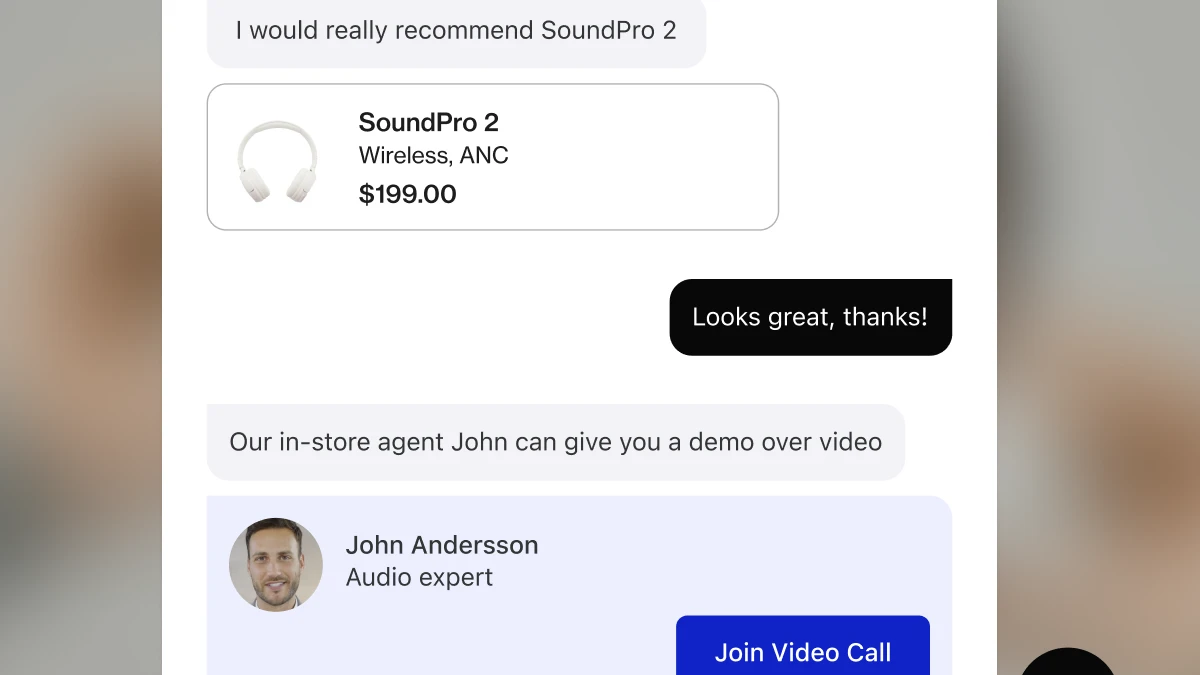
A shopper lands on a 75-inch TV product page. A small widget offers a live call with a product specialist. The shopper taps it. Within 30 seconds, they are face-to-face with an expert. This advisor can see their current living room setup via the shopper's phone camera. They can measure wall distance visually and recommend the right mount type before the shopper adds anything to their cart.
That interaction typically lasts six to twelve minutes. The advisor shares their own screen to walk through comparison charts. They pull up compatible accessories and add items directly to the shopper's cart during the call. The buyer avoids tab-switching. They stop hunting for answers across forums.
The format works differently than live shopping events. Live shopping is one-to-many, where a host presents to hundreds of viewers at once. Video consultation is one-to-one or one-to-few. The conversation is personalised to one buyer's exact situation. That focus helps sell high-consideration electronics where every purchase context is different.
Some retailers staff these calls with in-store associates during slow floor hours — turning idle payroll into revenue-generating interactions. Others build dedicated remote advisory teams. Elgiganten uses a hybrid: store staff handle calls during quiet periods, with a central team covering peak online hours. The deciding factor is call volume and product breadth. The model scales — Elgiganten now runs over 3,000 sessions per week across six countries.
What to Evaluate Before Launching video consultation for Electronics
Not every electronics retailer needs video consultation on day one. The format delivers the highest ROI when three conditions are true. First, average order value exceeds $200. Second, the product category involves compatibility or configuration questions. Finally, your return rate on that category sits above 10%.
Start by auditing your support tickets and chat logs. Look for phrases like "will this work with" or "what is the difference between" in your data. If they appear in more than 20% of pre-purchase inquiries, you have a strong signal. Those questions represent lost revenue. Text-based support channels simply cannot show, demonstrate, or visually confirm details.
Staff expertise matters more than headcount. Two advisors who genuinely know AV, computing, and smart home categories will outperform ten generalists reading from scripts. Elgiganten routes calls by product category — camera questions go to camera specialists, AV questions to AV experts — so each advisor operates within their depth. Conversion tracks to conversation quality, not queue speed.
Integration scope is the other gating factor. Your video consultation tool needs real-time access to your product catalogue, inventory, and cart system. If an advisor recommends a cable and it is out of stock mid-call, the experience breaks. Evaluate whether your ecommerce platform supports the necessary API connections before committing to a launch timeline. Retailers on Shopify, Salesforce Commerce Cloud, or headless architectures typically have the smoothest path. This aligns with Coresight Research's analysis of livestreaming commerce infrastructure (Coresight Research's livestreaming ecommerce trends report).
The Returns and AOV Impact of Pre-Purchase Expert Guidance
Elgiganten is the largest electronics retailer in the Nordics. They operate over 400 stores across six countries and run more than 3,000 video consultation sessions per week. Their conversion rate from those sessions hits 30%, with an average order value of $470. Customer satisfaction on video-assisted sessions exceeds 99%, according to Elgiganten's internal reporting. Those numbers did not come from a small pilot. They came from scaling the format across categories and countries over multiple years. You can read the full Elgiganten case study for the operational breakdown.
The returns impact is equally concrete. A shopper might spend ten minutes with an expert to confirm their TV fits their wall mount. The expert also checks if their receiver powers their speakers and if their HDMI cables support 4K@120Hz. After that chat, the buyer rarely sends the product back. Bambuser data shows products bought through video carry a 40% lower return rate than standard ecommerce purchases. The mechanism is simple: the buyer has seen the product demonstrated and had their specific questions answered before checkout.
AOV lifts because advisors naturally cross-sell and upsell during the conversation. They do not use scripted prompts. Instead, they act because the shopper's context is visible. An advisor might notice a ceiling-mounted projector and suggest a longer HDMI cable. That is a $60 add-on the shopper would never have found browsing alone.
Implementation Realities: Timeline, Staff, and Integration Costs
A realistic timeline from decision to first live call is four to eight weeks for most electronics retailers. The first two weeks cover platform integration. This connects your product feed, cart, and inventory systems. Weeks three and four focus on advisor training and workflow design. Teams decide who takes calls, when they happen, and how to escalate complex questions. The remaining time is soft-launch testing with a subset of PDPs before rolling out site-wide.
Staffing costs vary by model. Retailers can repurpose in-store associates during low-traffic hours. This adds near-zero incremental labour cost. Dedicated remote teams typically cost $15 to $25 per hour per advisor. The price depends on the technical depth required. At Elgiganten's scale of 3,000 weekly calls, the cost per interaction drops fast. It falls well below the cost of processing a single return on a $470 order.
Integration complexity depends on your tech stack. Shopify merchants can deploy via app-store installation and Google Tag Manager configuration in under a week. Salesforce Commerce Cloud requires a cartridge deployment. Headless builds use REST APIs and JavaScript SDKs. These are more flexible, but you must plan for dedicated developer time.
Budget for one hidden cost: call analytics. AI-powered transcription and session summaries surface recurring product questions, advisor performance gaps, and catalogue blind spots. This feedback loop tells you which categories benefit most from the investment and which advisors need coaching on specific product lines. Without it, you are running a service channel with no performance data — the equivalent of a store floor with no sales reporting.
Common Objections — and Where They Fall Apart
"Our chatbot already handles pre-purchase questions." It only handles the questions it was trained on. Compatibility questions involve thousands of product-pair combinations. No simple decision tree covers them all. A shopper might ask if a 2024 Samsung soundbar works with a 2022 LG TV via eARC. A chatbot either guesses or deflects. An advisor answers in seconds.
"Video calls won't scale." Elgiganten's operation — thousands of weekly sessions across six countries — proves otherwise. Scale is a staffing and scheduling problem, not a technology limit. Smart routing sends camera questions to camera specialists and AV questions to AV experts. This keeps wait times short. It also means not every advisor needs to know every product.
"Shoppers won't use video for electronics." Consumer trust in live video commerce continues to climb. Trust and product quality drive purchase decisions in live video commerce. This aligns with Coresight Research and their US livestreaming tracker.
"The ROI is unclear." You should measure three specific things. Track conversion rates on video-assisted sessions versus unassisted PDP visits. Monitor the return rate delta on video-assisted orders, and check the AOV difference. Your unassisted conversion might sit at 2% to 3%. If video-assisted sessions convert at 25% to 30%, the math resolves itself quickly.
Frequently Asked Questions
How long does it take to implement video consultation on an electronics ecommerce site?
Most electronics retailers go from contract to first live call in four to eight weeks. The timeline breaks into three phases. First is platform integration with your product catalogue and cart system, taking one to two weeks. Next is advisor training and workflow configuration for another one to two weeks. Finally, soft-launch testing on a subset of product pages takes one to two weeks before full rollout. Shopify-based stores can move faster, sometimes under two weeks. App-store installation handles much of the technical setup. Enterprise platforms like Salesforce Commerce Cloud require cartridge deployment and typically take longer.
Does video consultation reduce electronics return rates?
Yes, it does. A product expert confirms compatibility, demonstrates setup steps, and validates use-case fit during a live video call. This helps the shopper buy with significantly higher confidence. Elgiganten is the largest Nordic electronics retailer. They report over 99% customer satisfaction from video consultation sessions. Products purchased through video-assisted interactions carry measurably lower return rates. The mechanism is straightforward. The most common return reasons for electronics include compatibility issues or complex setups. A video advisor resolves these exact questions before checkout.
Can video consultation handle technical spec and compatibility questions in real time?
Absolutely. Advisors see the shopper's product page context instantly. They can share their own screen to walk through comparison charts and access the full product catalogue during the call. Compatibility questions often ask if a specific GPU fits a specific PC case. The advisor pulls up specs for both products simultaneously and gives a definitive answer. Some platforms also support the shopper sharing their phone camera. This allows the advisor to visually assess the buyer's existing setup in real time. They can check wall space, cable routing, and port availability.
What does video consultation cost compared to live chat or chatbot support?
Video consultation costs more per interaction than text-based chat. Industry benchmarks put it at roughly $8 to $15 per session when factoring in advisor time and platform fees, compared to $2 to $5 for live text chat and near-zero marginal cost for chatbots. However, the ROI calculation flips when you factor in conversion rate and order value. A chatbot interaction on a $500 TV page might convert at 1% to 2%. A video consultation on the same page converts at 25% to 30%. It also brings a higher average order value due to natural cross-selling. Elgiganten sees a $470 AOV on video-assisted purchases. This means the cost per session is a tiny fraction of the incremental revenue generated. The right comparison is not cost per interaction. It is revenue per interaction.




.png)