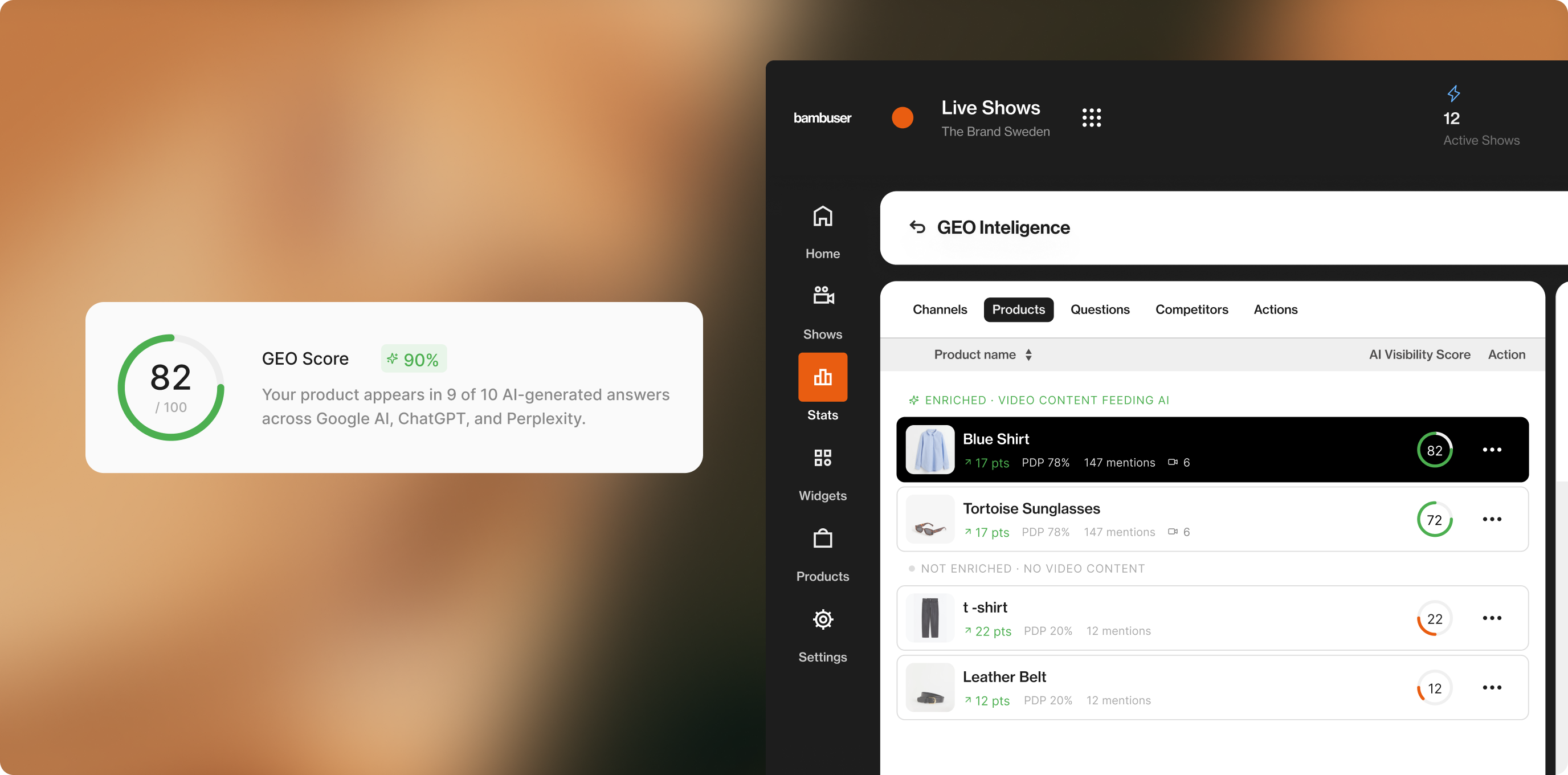
The rise of generative AI answer engines is rewriting product discovery. Brands that feed these engines with structured, authoritative data get cited. Brands that don't get skipped. Bambuser's Intelligence Layer closes that gap - automatically. Across every video format you already produce.
--
When someone asks ChatGPT or Perplexity "what are the best running shoes for flat feet?", they don't get a list of links. They get an answer. A synthesized, confident, source-cited answer assembled from structured data across the web: schema markup, FAQ content, product metadata, semantically dense text.
Your live shopping show from last Tuesday - the one where your footwear specialist spent 40 minutes walking through exactly that question - contributed nothing to that answer. Neither did the customer unboxing video that went viral on TikTok. The AI engines never saw any of it. The moment those videos were published, most of their value disappeared into formats that search infrastructure can't process.
That gap is the defining discovery problem of 2026. And it's getting wider every month.
The New Search Stack Most Brands Are Missing
Search is fragmenting faster than most marketing teams have adjusted for. Google remains the dominant gateway, but an accelerating share of product discovery is moving inside AI-powered answer engines - ChatGPT, Perplexity, Google AI Overviews, Gemini. By 2028, AI-powered search is projected to influence 30–50% of all search activity (Gartner, Semrush, McKinsey), with $750B in US consumer revenue flowing through AI-driven discovery (McKinsey, 2025).
These engines don't crawl video. They don't watch streams. They read structured data: schema markup, FAQ blocks, product descriptions, and semantically rich text. Brands that produce that structured layer get cited. Brands that don't get skipped.
This is Generative Engine Optimization - GEO - and it sits alongside SEO and AEO (Answer Engine Optimization) as the new discovery stack every brand needs to master. The problem isn't awareness. Most content teams understand that structured data matters. The problem is production cost. A single live show takes eight or more hours of post-production work to become GEO-ready: transcription, tagging, FAQ writing, schema markup, SEO copy, product data extraction. That same cost applies to every pre-recorded tutorial, every customer review video, every influencer unboxing. At that cost, most brands optimize a fraction of their content and leave the rest invisible.
The Asset You're Already Sitting On
Before explaining what Bambuser's Intelligence Layer does, it's worth sitting with what makes the problem unique - and what makes this solution genuinely different from yet another AI content tool.
The most valuable product knowledge inside a brand rarely lives in polished, published content. It lives across a much wider and more varied content ecosystem than most teams account for.
- It's in the non-live video archive: the product tutorial that runs as evergreen content on your PDPs, the pre-recorded demo your sales team sends to prospects, the step-by-step how-to filmed two years ago that still gets thousands of views a month. These assets contain authoritative, structured product knowledge - often more precise and detailed than live content because they were scripted - but their intelligence sits locked inside an unindexed video file.
- It's in your UGC library: the customer unboxings shared on TikTok, the authentic reviews posted to Instagram Reels, the influencer walkthroughs that reach audiences your brand content never could. UGC is particularly powerful for AI engines - it contains real customer language, genuine use cases, and the kind of authentic comparison framing that answer engines weight heavily. A customer explaining why these shoes fixed their knee pain after trying four other brands, in their own words, is exactly the kind of structured knowledge Perplexity is built to surface. But only if that knowledge is extractable.
- It's in the private content that was never meant to go public: the store associate training video where a product expert walks through every ingredient, the internal founder demo that contains every key differentiator, the supplier walkthrough loaded with handling tips and use cases your support team answers daily.
The Intelligence Layer processes all of it - published or private, live or recorded, brand-produced or user-generated. The video stays where it is. Only the extracted intelligence gets deployed.
The content doesn't need to be published. Only the extracted intelligence does.
This fundamentally changes the math. Every video a brand has ever produced or collected - in any format, from any source - becomes a potential source of structured, discoverable product knowledge.
What the Intelligence Layer Actually Produces
From a single video asset - whether it's a live show replay, a pre-recorded tutorial, or a UGC clip submitted by a customer - the Intelligence Layer generates:
- Full transcripts with speaker identification and key-moment deep links
- SEO-optimized product descriptions and page copy
- FAQ content derived from actual product discussions
- VideoObject schema markup ready for deployment
- Product information blocks covering attributes, pricing context, and sentiment
- Authentic customer language patterns extracted from UGC, formatted for structured deployment
All of it formatted for direct on-page integration.
This isn't summarization. It's not AI-generated filler padded to hit a word count. It's structured value extraction: taking the unstructured expertise inside your video content - regardless of format or source - and converting it into the exact data formats that search engines, AI answer engines, and product pages are built to consume.
The Intelligence Flywheel
Less human in the loop. More value extracted.
.png)
The real power of the system is that it compounds. The Intelligence Layer runs as a closed-loop flywheel across five stages:
(1) Create: content enters through live shows, UGC, or private recordings.
(2) Extract: AI processes it into transcripts, metadata, FAQs, schema, and tags.
(3) Deliver: structured output deploys - automatically, or in co-pilot mode - across SEO, GEO, and AEO surfaces.
(4) Measure: Bambuser’s GEO Score tracks how visible each product is across every major AI anser engine.Think of it as a search ranking for the AI era: one number that tells you whether your product is being cited, summarised, or ignored. The built-in GEO Scanner lets you benchmark against competitors and spot gaps before they widen.
(5) Optimize: the system identifies visibility gaps, recommends actions, and auto-enriches content.
Each cycle: less human in the loop. More value extracted. What starts as assisted content production evolves into an autonomous discovery engine - one that gets more effective as the content library grows.
The UGC loop is particularly powerful here. As customers generate video content about your products, that authentic voice feeds back into your structured intelligence - continuously enriching the exact signals AI answer engines trust most.
Consider a beauty brand producing 20 live shows per month, alongside a backlog of 200 pre-recorded tutorials and an active UGC program generating 50+ customer videos monthly. Under a manual workflow, processing even a fraction of that at eight hours per asset is operationally impossible. With the Intelligence Layer, the same coverage runs on automated processing, freeing the content team entirely for creative strategy.
The Number That Should Change How You Think About This
Manual post-production for a single video asset - live show, recorded tutorial, or UGC clip - averages approximately eight hours of human work: transcription, tagging, writing SEO copy, building FAQs, adding schema markup. The Intelligence Layer compresses that to roughly a few minutes of automated processing - a major reduction in time-to-value per content asset. If the e-commerce team even bothers. Most don't - and that's the real problem. The eight-hour cost isn't a bottleneck; it's a full stop. Content gets published, the live stream ends, the UGC comes in - and none of it ever gets touched again.
But the more important shift isn't the cost reduction. It's the coverage. When the production cost drops by that much, you stop making calculated bets about which content is worth optimizing and start optimizing everything. The long tail of your video library - the live session that got 400 viewers, the pre-recorded how-to from 2023, the customer unboxing that went semi-viral on TikTok, the private training video your team filmed for onboarding - all of it becomes a working discovery asset.
The brands that recognize this first will have a structural advantage that only compounds over time.
The New Data Supply Chain for AI Discovery
The brands that win in AI-driven discovery won't necessarily be the ones with the best products. They'll be the ones that become the most reliable, structured data suppliers to the engines making the decisions.
This is a fundamentally different strategic frame. It's not about creating more content. Most brands are already drowning in it. It's about converting the content you have into the formats that AI infrastructure is hungry for: structured product data, authenticated expert language, real customer voice at scale.
Three forces are converging to reshape how products get discovered, and they create an opening that most brands haven't recognised yet.
First, AI answer engines are replacing search results with direct answers. ChatGPT, Perplexity, and Google AI Overviews don't return ten blue links. They return one synthesised response. The brands that feed those engines structured, citable data will be the ones that get cited.
Second, video has become the richest source of product knowledge most brands own. Live shows, recorded tutorials, and short-form content contain expert-level detail that no product page matches, but that knowledge is locked inside a format AI engines can't read.
Third, UGC is now the most trusted signal in the discovery stack. A real customer explaining why a product solved their problem carries a credibility that brand copy never will, and it's exactly the kind of authentic, experience-based content AI engines are trained to prioritize.
Bambuser's Intelligence Layer sits at the intersection of all three. It takes the unstructured expertise locked inside your video content, brand-produced and customer-generated alike, and converts it into the structured data AI engines need to surface your products. Every video, live or recorded, becomes a working data asset feeding the engines that increasingly decide what gets discovered, recommended, and bought.
Where This Is Going
Bambuser built the platform that brought live video to e-commerce. The Intelligence Layer is the next evolution of that thesis: turning every video touchpoint - live, recorded, branded, or user-generated - into a compounding discovery asset that feeds the AI engines increasingly driving product decisions.
As those engines become the primary interface between consumers and products, the brands that feed them with structured, authoritative, expert-led data will own the conversation. The brands that don't will become invisible - not because their products are worse, but because their knowledge is trapped in formats AI answer engines can't read.
The video is the source. The intelligence is the product.




.png)