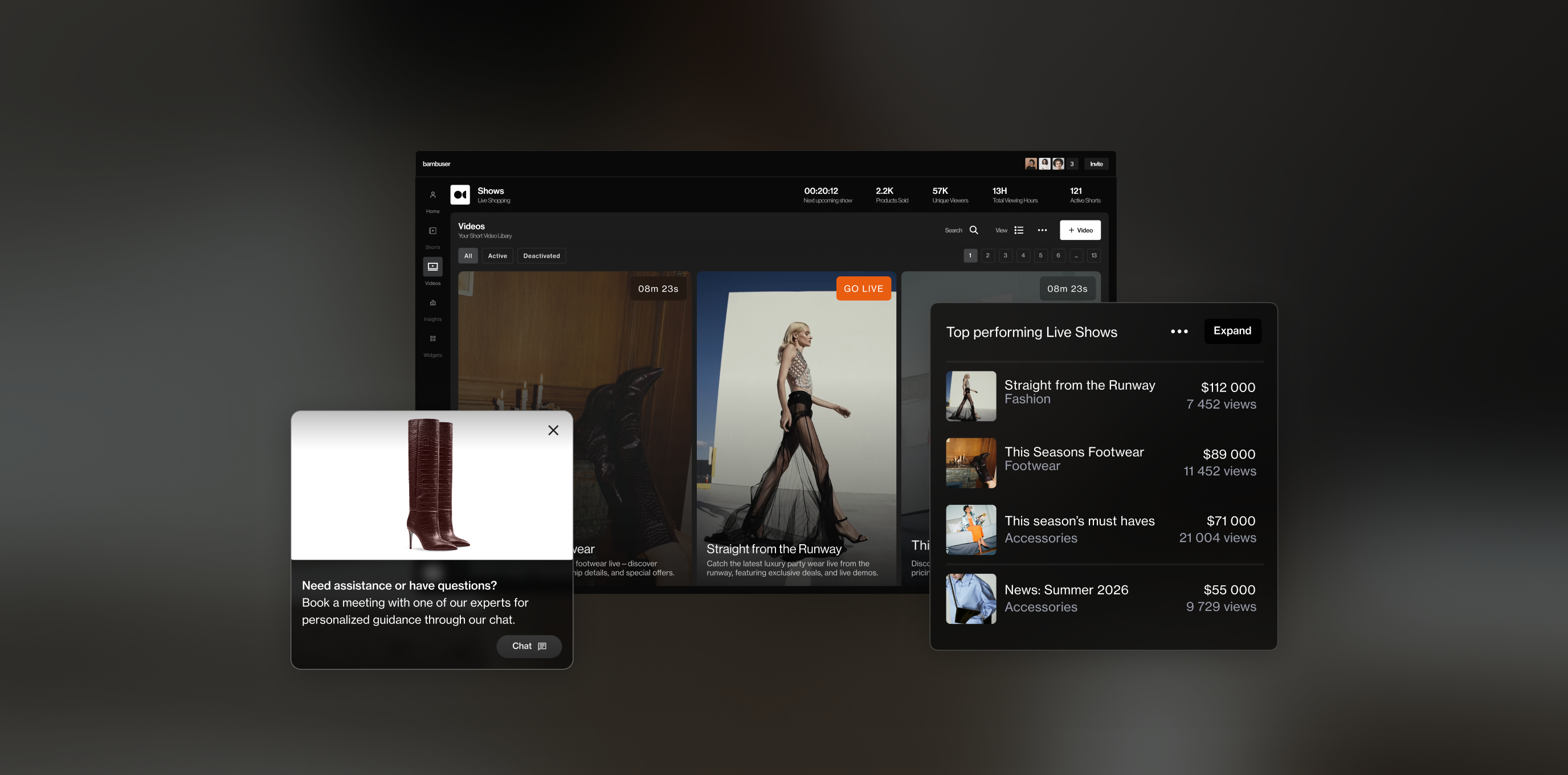
Bambuser and Firework answer the same buyer questions in different ways. This comparison puts eleven of those questions to both platforms, row by row, and names the stronger side where the evidence supports one, including the rows Firework wins.
QUICK ANSWER: Bambuser fits brands whose video strategy centres on their own storefront; Firework fits brands that want video distributed across many channels. Bambuser is built for depth on the brand's own site: four products that run there, its own streaming technology and one-to-one video selling with add-to-cart in the call. It adds the choice to keep customer data in the EU, and UGC import that clears usage rights as it goes. Firework is built for reach: video distributed across email, SMS, apps, in-store screens and a publisher and retail-media network, plus a digital-human avatar and a 24/7 Video Showroom.
Table of Contents
- Bambuser vs Firework at a Glance
- Live Shopping Technology: Who Owns the Streaming Stack
- Live Shows and Shoppable Video on the Product Page
- One-to-One Clienteling and the Digital-Human Question
- Distribution: Where Firework Is Simply Stronger
- Bambuser vs Firework Pricing: List Rates Versus What You Actually Pay For
- Security, Residency and Proof
- Which Platform Fits Your Brand
- Frequently Asked Questions
Bambuser and Firework are the two names that come up most often when retail teams evaluate video commerce, and on the surface they look interchangeable: both promise shoppable video, live shopping and a lift in conversion. Underneath, they are built on different bets. One vendor concentrated its engineering on the brand's own storefront. The other concentrated on getting video everywhere else. Almost every difference in this comparison traces back to that split.
Bambuser vs Firework at a Glance
Each row asks one question; both columns answer it. The final column calls the winner.
| The buyer question | Bambuser | Firework | Who wins |
|---|---|---|---|
| What is the platform built around? | Four products that all run on the brand's own site: Live Shopping, Shoppable Video, Video Consultation and Live Chat. | Formats built to travel: shoppable video, livestream, 1:1 chat and a 24/7 Video Showroom, distributed across owned channels plus a publisher and retail-media network. | DependsOwn your storefront experience, or reach across many channels. |
| Who owns the streaming technology behind live shopping? | Runs its own live-video stack, built since it broadcast the first mobile live stream in 2007. | Streams over Amazon IVS, AWS's managed live-video service. | BambuserBambuser controls its own stack; Firework builds on AWS. |
| What can a viewer do inside a live show? | Tap product cards, answer polls and quizzes, add to cart and buy without leaving the stream. | Tap product cards and buy without leaving the stream. | BambuserNarrowly: polls and quizzes add interaction Firework's live player lacks. |
| What does shoppable video include on site? | Clickable products with add-to-cart in the player, shoppable clips cut automatically from live shows, Stories placements and an in-video wishlist. UGC import pulls from Instagram by tag or mention and from the brand's own site, clearing usage rights as it goes. | Clickable product tags, polls and carousels across home, collection and product pages, with bulk import from TikTok and Instagram. | BambuserBambuser sources from social and the brand's own site, and clears the rights. |
| What does the one-to-one product include? | Co-browsing (advisor and shopper browse the site together), queue and appointment booking, add-to-cart during the call, AI call insights and transcripts, call forwarding to mobile. | Co-browsing, waitlist management and scheduling (via a Calendly integration), plus an AI co-pilot that triages incoming chats; no in-call add-to-cart and no AI call transcripts or summaries. | BambuserOnly Bambuser sells inside the call and adds AI insights after it. |
| Does a digital human or AI presenter exist? | Bambuser puts human hosts and advisors in front of shoppers; its AI works behind the scenes on subtitles, clipping and call insights. | The AVA digital-human avatar (2024) plus a conversational AI Shopping Agent. | FireworkFirework has the avatar; Bambuser bets on human advisors. |
| Where can video reach shoppers beyond the brand's site? | The brand's app, plus simulcast to Instagram, Facebook and YouTube. No publisher or retail-media network. | Email, SMS, apps, in-store screens, QR on packaging, plus a publisher and retail-media network. | FireworkA clear win: its publisher network has no Bambuser equal. |
| What do the published prices look like? | Four tiers on bambuser.com/pricing: Free $0, Essential $79/mo, Pro $249/mo, Enterprise custom. Metered on monthly views, $0.25 per view over the allowance; only views longer than 3 seconds are billable (shorter views count as impressions and are not billed). | Three tiers on its Shopify listing: Pilot free, Starter $39/mo ($10 per 1,000 views over), Growth $259/mo ($5 per 1,000 views over). Its firework.com/pricing page lists five tiers with overage rates but no base prices; enterprise, 1:1 Video Chat and Video Showroom are quote-only. | DependsFirework is cheaper at list; Bambuser publishes every tier in dollars and bills only views over 3 seconds. |
| Which security credentials does each hold? | ISO 27001 certification (Stockholm site), independent penetration tests at least annually and MFA on all critical systems including production. No SOC 2 in its own name, though its cloud providers hold SOC 2/3. | SOC 2 Type 2 (BARR Advisory, announced 2023) across five trust criteria plus HIPAA Security Rule requirements. Its compliance page publishes no report period, renewal date or penetration-testing commitment, and no ISO 27001 certification. | BambuserISO 27001 is audited and renewed; Firework gives no date for its SOC 2, so its age is unknown. |
| Where can customer data live? | EU or US, selected by the customer. | US by default; no published EU hosting option. | BambuserThe only one offering EU data residency. |
| How are they rated on G2, where enterprise buyers research? | 4.6 stars from 28 reviews, 77% of them five-star. | 3 reviews. | BambuserFirework's larger review base sits on the Shopify App Store, where self-serve merchants review. |
Live Shopping Technology: Who Owns the Streaming Stack
Bambuser runs its own live-video stack, built on technology it has developed since broadcasting the world's first mobile live stream in 2007. Firework streams over Amazon IVS, the managed service from AWS. Owning the stack buys control and a roadmap set by commerce needs rather than a cloud provider's priorities; building on IVS buys proven infrastructure at global scale without the maintenance burden. It is a real architectural difference, not an automatic performance win, so if stream reliability decides your evaluation, test both on your own traffic.
Live Shows and Shoppable Video on the Product Page
Inside a live shopping show both players cover the buying basics: tappable product cards and purchase without leaving the stream. Bambuser adds polls and quizzes on top, and the effect on buying behaviour is not small: at Kappahl, viewers who engaged with in-show polls converted at 36.54%, against 7.53% for viewers who did not. Interaction is the mechanism that turns a passive viewer into a buyer. Firework's live player offers product cards and purchase, and stops there.
On the product page, each platform is built to recycle a different content source. Bambuser turns ended live shows into tagged shoppable video clips automatically, alongside Stories placements and an in-video wishlist. Its UGC import pulls from Instagram by tag or mention and from the brand's own site, securing usage rights as it goes. Firework leans on social, with bulk import from TikTok and Instagram. Brands producing live shows get more from Bambuser, because one broadcast becomes a library of product-level clips, and because the same import path also recycles the video a brand already owns elsewhere.
One-to-One Clienteling and the Digital-Human Question
Both vendors sell a one-to-one video product for clienteling: the advisor-led personal selling a shopper would get from a great store associate in person. Both cover co-browsing, queuing and scheduling, so the difference is what happens inside the call. Bambuser's Video Consultation lets the advisor add products to the shopper's cart during the conversation and generates AI call insights and transcripts afterwards. It also forwards calls to mobile, so an in-store advisor can show products from the shop floor. Firework documents neither in-call add-to-cart nor per-call AI summaries. On digital humans the two diverge by design: Firework offers the AVA avatar, Bambuser deliberately does not, betting that considered purchases convert on human expertise.
Distribution: Where Firework Is Simply Stronger
This is Bambuser's clearest losing row. Beyond the brand's own site and app, Bambuser simulcasts to Instagram, Facebook and YouTube. Firework syndicates video across email, SMS, in-store screens and QR on packaging, and operates a publisher and retail-media network with no Bambuser equivalent. If your goal is pushing video onto as many surfaces as possible, including ones you do not own, Firework is structurally ahead. The counterweight is ownership: video on your own storefront builds your data, your search visibility and your customer relationships, while video spread across a network builds reach on surfaces the network controls.
Bambuser vs Firework Pricing: List Rates Versus What You Actually Pay For
Bambuser publishes all four tiers on its own pricing page: Free, Essential at $79 per month, Pro at $249 and a custom Enterprise tier. Firework's dollar figures live on its Shopify App Store listing, Starter at $39 and Growth at $259, while its own pricing page lists tiers and overage rates without base prices. At list rates Firework is cheaper. But the two count a view differently: Bambuser bills only views longer than 3 seconds, and anything shorter is an unbilled impression. Bambuser also costs more at list but includes more per tier, so model both against your real volumes before treating either as the cheap one.
Security, Residency and Proof
Security splits along your procurement checklist, though not evenly. Bambuser holds ISO 27001 for its Stockholm site and commissions independent penetration tests at least annually. Firework holds SOC 2 Type 2 across five trust criteria plus HIPAA Security Rule requirements, but its compliance page publishes no report period, no renewal date and no penetration-testing commitment. A buyer whose checklist names SOC 2 outright will still want Firework's report. Data residency is less balanced: Bambuser lets the customer choose EU or US, while Firework hosts in the US and publishes no EU option, which for EU-regulated retailers often settles the question on its own.
On proof, G2 is where enterprise software buyers research, and there Bambuser holds 4.6 stars from 28 reviews against Firework's 3. Customer results point the same way: Bambuser data shows shoppers watching shoppable video are 225% more likely to add items to cart, and the Kappahl poll figures above tell the same story. Both are vendor-reported, but they are consistent with what interactive video does to purchase behaviour on a brand's own site.
Which Platform Fits Your Brand
Choose Bambuser when
- Your video strategy centres on your own storefront, and the experience, the data and the customer relationship should stay there.
- One-to-one selling matters: add-to-cart inside the call and AI call insights, neither of which Firework documents.
- EU data residency or ISO 27001 sit on your procurement checklist.
- You run live shows and want each one to become a library of shoppable clips without extra editing work.
- You want customer video on your product pages with the usage rights cleared as it imports.
Choose Firework when
- Distribution is the goal: email, SMS, in-store screens, QR and a publisher network Bambuser has no answer to.
- You want a digital-human avatar or an always-on AI shopping agent in front of customers.
- Format breadth matters: shoppable video, livestream, 1:1 chat and a 24/7 Video Showroom from one vendor.
- Your video already lives on TikTok and Instagram, and the job is moving it on-site in bulk.
- You buy self-serve and want the lowest published entry price.
Whichever way you lean, test rather than trust. Run both on your own traffic for a month, with the same products and the same placements, and measure add-to-cart, conversion and cost per engaged viewer in your own analytics. A comparison table, this one included, is where the evaluation starts, not where it ends.
Frequently Asked Questions
Is Firework the same company as Fireworks AI?
No. Firework is a video commerce platform operated by Loop Now Technologies, based in San Mateo, California. Fireworks AI is a separate, unrelated company in machine learning infrastructure. When you compare vendors, make sure you are evaluating firework.com.
Which platform is cheaper, Bambuser or Firework?
Firework is cheaper at the published list rates: its Starter tier is $39 per month against Bambuser's Essential at $79 per month, and its overage runs $5 to $10 per 1,000 views against Bambuser's $0.25 per view. But the two count views differently. Bambuser bills only views longer than 3 seconds, and shorter views count as impressions that are not billed, so the effective cost per engaged viewer can land much closer than the list rates suggest. Bambuser also generally includes more per tier. Model your own traffic before deciding.
Can I keep customer data in the EU?
With Bambuser, yes: data residency is customer-selectable between the EU and the US. Firework hosts in the US by default and publishes no EU hosting option. For EU-regulated retailers this is one of the clearest differences between the two platforms.
Which is better for one-to-one clienteling?
Bambuser. Both platforms cover co-browsing, queuing and scheduling. The gap is what happens inside and after the call: Bambuser's Video Consultation supports add-to-cart during the call and generates AI call insights and transcripts, neither of which Firework documents for its 1:1 Video Chat.
Does either platform take payment inside the video player?
In their documented models, neither does. Both let shoppers add to cart inside the player and complete payment in the store's own checkout. Firework announced an in-video checkout in 2022, but it is not documented as a current product. It is absent from its product and pricing pages and from its Shopify App Store listing. The help-centre articles covering the setting are no longer published, and its developer documentation states that the merchant owns the cart and the checkout flow. One exception: Firework's Salesforce Commerce Cloud guide still includes a Native / Instant Checkout step whose permissions reach order creation, so on that stack it is worth asking Firework directly. If payment completing inside the video is a hard requirement, ask both vendors to demonstrate it live.
Is Bambuser or Firework better for luxury and fashion retailers?
Bambuser is the closer match for luxury and fashion brands built around their own storefront; Firework is the closer match when reach is the priority. Both serve fashion, but they answer different needs. Bambuser's strengths fit considered, high-touch selling: one-to-one Video Consultation with add-to-cart during the call, human advisors rather than digital avatars, EU data residency, and fashion proof such as Kappahl, where poll-engaged viewers converted at 36.54%. Firework fits fashion brands whose priority is syndicating video across email, SMS, in-store screens and its publisher network.




.png)